 EN
EN

Why Military Patches Matter: Tradition, Compliance, and Brand Identity
Symbolic heritage and unit cohesion in military patch culture
Military patches do much more than look good on uniforms. They're actually pieces of history that tell stories about who we are, where we come from, and what we stand for together. Since time immemorial, military units have relied on these small symbols to pass down their stories, commemorate battles fought, and express fundamental beliefs. Think about it: an eagle emblem might represent strength and freedom, crossed swords could signify combat readiness, while specific campaign images remind soldiers of past victories. When troops wear these patches day after day, something happens inside them. They start feeling connected not only to their current comrades but also to those who served before them. A recent study in Military Psychology Review showed pretty interesting results too. Units that maintained consistent patch usage saw around 23% boost in overall morale levels compared to others. Makes sense really - when people see themselves as part of something bigger than just themselves, they tend to perform better under pressure and stick together through tough times.
Regulatory essentials: Navigating AR 670-1, AFI 36-2903, and authorized insignia rules
Following uniform regulations isn't just recommended—it's mandatory for military personnel. Both the Army through AR 670-1 and the Air Force via AFI 36-2903 have strict rules covering everything from how big patches should be to exactly where they need to go on the uniform (think half an inch below the shoulder seam). There are also clear guidelines about colors—some situations call for subdued tones while others allow full color—and what symbols are actually allowed. Certain designs get rejected outright because they include things like unauthorized coats of arms or company logos. Getting approval means going through official channels first with the unit commander, and sometimes even checking in with specialized groups like the Army Institute of Heraldry when history matters. These reviews help maintain accuracy, respect cultural sensitivities, and keep with the spirit of each branch. Looking at recent data from the DoD compliance report shows why this matters so much: nearly three quarters of all uniform issues last year were traced back to incorrect patches alone. So whether making uniforms or managing troops, understanding these rules isn't just paperwork—it directly impacts operational readiness and avoids unnecessary disciplinary problems down the line.
Designing Custom Military Patches: Artwork Standards and Approval Workflow
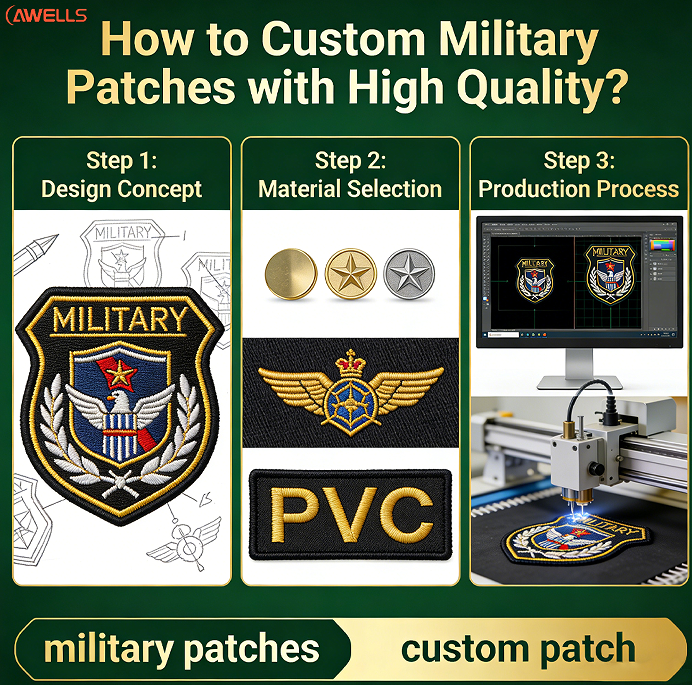
Creating custom military patches demands precision at the intersection of symbolism, regulation, and manufacturability. Success hinges on translating heritage and intent into production-ready assets—without compromising durability, legibility, or compliance.
From concept to vector art: DPI, color limits, and embroidery-ready file requirements
Artwork must meet exacting technical thresholds before digitization:
- Vector format only (.AI, .EPS, or native Illustrator files)—no raster-based submissions
- Minimum 300 DPI resolution at final size to preserve edge fidelity during scaling and stitching
- Strict 6–8 color palette limit, optimized for thread availability and embroidery clarity
- All text sized to 0.2 inches minimum height, verified at actual sew-out scale
- Layered files required to isolate stitch paths (e.g., fill, outline, satin, puff) for machine-specific programming
These standards prevent costly rework and ensure designs translate faithfully from screen to fabric—even at high-speed industrial embroidery rates.
Free design support and unlimited revisions: Ensuring accuracy and regulatory alignment
Expert guidance bridges creative vision and regulatory reality:
- Mil-spec validation against AR 670-1 and AFI 36-2903—conducted before digitization begins
- Digitization proofs showing stitch direction, density, and backing interaction
- Border-spacing audits to prevent fraying during final trimming and wear
- Grading adjustments calibrated for fabric type (e.g., ripstop nylon vs. polyester-cotton twill)
This workflow eliminates guesswork, accelerates command-level approval, and safeguards heritage integrity across Army, Air Force, Navy, and Marine Corps applications.
High-Quality Military Patches Production: Materials, Techniques, and Durability
Embroidered vs. woven vs. PVC military patches: Performance trade-offs for field use
Field performance dictates material selection—not aesthetics alone.
- Embroidered patches use layered thread on twill or felt backings, delivering classic texture and dimensional depth—but limited fine-detail resolution and moderate abrasion resistance.
- Woven patches, created on Jacquard looms, achieve crisp, small-text legibility and tight edge definition—ideal for unit mottos or intricate heraldry—yet lack tactile dimension and structural rigidity under repeated flexing.
- PVC patches, injection-molded from durable synthetic polymers, offer true 3D form, chemical resistance, and full waterproofing—making them indispensable for tactical gear, maritime units, or environments involving solvents or submersion.
Each has a role: embroidered for tradition-rich uniforms, woven for precision-driven identification, and PVC for mission-critical resilience.
Stitch density, thread count, and backing stability: What defines premium military patches
Premium patches are engineered—not assembled. Critical benchmarks separate functional from field-worthy:
- Stitch density ≥7,000 stitches per square inch, preventing unraveling even after sustained abrasion
- High-twist, UV-stabilized polyester thread, engineered to retain color intensity through 2+ years of sun exposure
- Thermoplastic laminate backing, which bonds permanently to fabric through heat activation and withstands 100+ industrial wash cycles without delamination
| Feature | Standard Quality | Premium Quality |
|---|---|---|
| Stitch Density | 5,000–6,000 stitches/in² | 7,000+ stitches/in² |
| Backing | Basic adhesive | Thermoplastic laminate |
| UV Resistance | 6-month fade resistance | 2+ year colorfast guarantee |
Combined with merrowed (overlock) edges—reinforced stitching that seals fabric layers—these features ensure patches remain legible, secure, and mission-ready across deployments, training cycles, and daily wear.
Finalizing Your Order: Sizing, Attachment, and Operational Fit for Military Patches
Getting the right size and choosing proper attachments makes all the difference when it comes to following regulations, how well things work, and staying safe. Always measure where something goes on the real uniform itself rather than relying on templates. Most sleeve patches are about 3 to 5 inches across, whereas those little badges for caps usually measure somewhere between 2 and 4 inches. Going outside these ranges can cause problems meeting requirements set out in documents like AR 670-1 or AFI 36-2903 for specific placement areas. When picking how to attach items, think about what they'll actually face in daily use. For example, if something gets washed frequently or worn during physical activity, stronger fastenings might be necessary compared to items that stay put under normal conditions.
- Hook-and-loop (Velcro®) enables rapid gear swaps for tactical vests or modular uniforms—but requires compatible loop panels and regular cleaning to maintain grip.
- Merrowed-edge embroidery provides permanent, laundering-resistant integration for daily-wear uniforms.
- Sew-on with reinforced perimeter stitching offers maximum stability for high-abrasion roles (e.g., aviation, armor, special operations).
Always verify thickness, backing adhesion, and environmental resilience—especially for units operating in extreme heat, saltwater, or chemical-exposure scenarios. Final specifications must reflect real-world conditions—not just aesthetic preference.
FAQ
Q: Why are military patches important?
A: Military patches symbolize history, heritage, and unit cohesion, boosting morale and connecting troops with past traditions.
Q: What are the regulations for military patches?
A: The Army's AR 670-1 and Air Force's AFI 36-2903 provide strict guidelines on size, placement, colors, and symbols allowed on uniforms.
Q: What materials are used for military patches?
A: Military patches can be embroidered, woven, or made from PVC, each offering different benefits such as texture, legibility, and durability.
Q: What defines premium military patches?
A: Premium patches feature high stitch density, UV-stabilized threads, thermoplastic backing, and merrowed edges for durability and legibility.
Table of Contents
- Why Military Patches Matter: Tradition, Compliance, and Brand Identity
- Designing Custom Military Patches: Artwork Standards and Approval Workflow
- High-Quality Military Patches Production: Materials, Techniques, and Durability
- Finalizing Your Order: Sizing, Attachment, and Operational Fit for Military Patches